Press Release: Central and Eastern Europe Needs Modern Mental Health and Addiction Policy
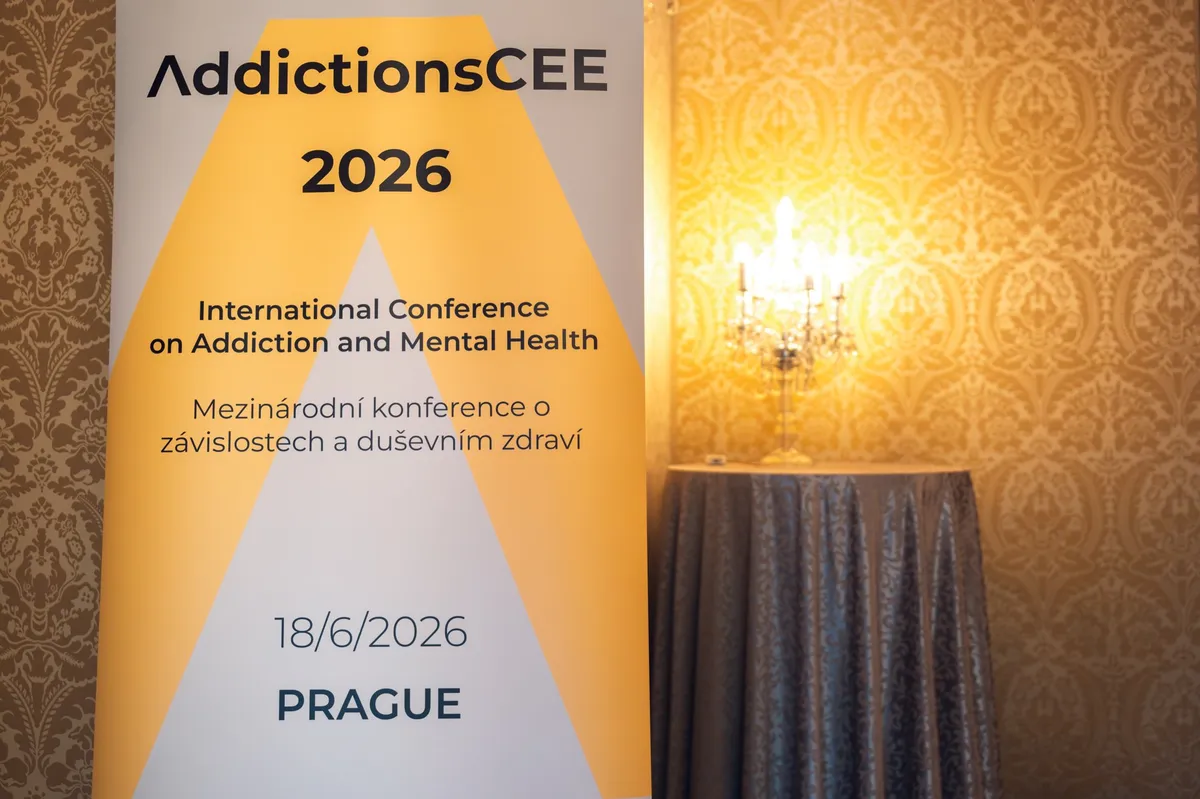
Experts from the AddictionsCEE 2026 conference presented joint recommendations.
Substance use and mental health policy in Central and Eastern Europe needs a modern, rational, integrated, and evidence-based framework. Experts from several European countries agreed on this at the fourth annual AddictionsCEE 2026 conference in Prague, which followed previous editions of AddictEU in Brussels and AddictCZSK in Bratislava. The outcome of the conference is the Memorandum AddictionsCEE 2026, outlining recommendations for public policy in addiction, mental health, prevention, treatment, and regulation based on risk levels.
The international AddictionsCEE 2026 conference further expanded expert dialogue on addictions and mental health across a broader region of Central and Eastern Europe. It brought more than 20 speakers from Europe representing the fields of addictionology, psychiatry, public health, regulation, research, and civil society to Prague, offering four specialized panels focusing on current trends in addiction policy, legal and illegal substances, new psychoactive and psychomodulatory substances, digital addictions, and the integration of addiction and mental health policies.
The debate also confirmed that addictions can no longer be understood solely as a narrowly defined drug agenda. They are increasingly moving into a broader framework of public health, mental health, youth protection, chronic disease prevention, digital safety, and social stability, thus requiring more coordinated and rational public policy. This applies not only to legal and illegal substances but also to gambling, psychoactive medications, and digital addictions, whose health and social impacts can no longer be ignored.
“Drug policy in Europe needs modernization. It is not enough to distinguish between legal and illegal substances; it is necessary to evaluate their different risks and social impacts. We recommend regulating addictive substances according to the degree of harm, supporting less risky substances and products including differentiated gambling products, strengthening prevention and treatment, and using tax policies for this purpose. At the same time, there is a need to integrate health, social, and economic aspects. In times of unprecedented growth in black markets for gambling, alcohol, and especially cigarettes, security risks have become the most pressing issue for EU states and the entire EU. The outflow of funds to hostile countries calls for coordination at the highest level, not just from a health perspective. The Czech Republic’s diverse experiences show that data-driven, science-based policies grounded in risk proportionality can yield better results,” said Jindřich Vobořil, chairman of the board of trustees of RATIO - Think tank for rational addiction policies.
One of the main conclusions of the conference is the need for an integrated addiction strategy that does not separate legal and illegal substances but allows evaluating individual products and forms of addictive behavior according to their actual harm. This approach, experts argue, would enable better setting of public policy priorities, planning services, and more effective use of public resources.
The Czech model serves as a significant reference in this regard within the region. The AddictionsCEE 2026 memorandum notes that Czech policy has gradually shifted from a narrow anti-drug framework to an integrated approach to addictive behavior that includes legal and illegal substances, gambling, psychoactive medicines, and problematic use of digital media, relying on data, harm reduction access, service coordination, and regulation according to actual risk levels.
“There are significant differences in approach to prevention, treatment, and regulation of substances with addictive potential across Central and Eastern European countries. Nevertheless, it is increasingly evident that a common denominator for successful policies is working with data, focusing on prevention, and the ability to respond to new phenomena before they become serious social problems. In the Czech environment, the harm reduction approach has proven effective. This approach is an integral part of prevention, treatment, and accessible services, addressing not only illegal drugs but also alcohol, tobacco, gambling, and digital addictions.” Ladislav Csémy, President of the Institute for Mental Health and Addiction Studies, stated.
“In addiction care, we rarely encounter a gap between us and science; rather, we often face a gap between scientific knowledge and the ability to act upon it. In Romania, laws prevent people from helping each other: drug use and possession are criminalized, and providing space for their use is also a crime. This practically eliminates the possibility of creating supervised consumption sites or testing services. Even naloxone, a legal and proven effective tool for reversing overdoses, is not widely available in a form that individuals can carry with them, thus rarely reaching those who need it at critical moments. It’s not what we don’t know that limits us, but rather what the law doesn’t allow us to do,” Casian Stan, physician and psychotherapist from ARAS - Romanian Association for AIDS Prevention, said.
The integration of mental health and addiction policies was one of the key themes throughout the entire conference. Experts highlighted that an effective response must combine prevention, accessible care, social reintegration, support for vulnerable groups, and better coordination between psychiatry, psychology, primary care, education, and social services.
“The Czech Republic has understood that repression alone is not enough, treatment alone is not enough, and prevention alone is not enough. Success comes only when all these tools work together. Europe today needs the courage to acknowledge that some traditional approaches do not work, to change regulation where data show a need for it, and to listen to science. Facts are not a matter of opinion, and public policy cannot be built on impressions,” said Pavel Bém, National Drug Policy Coordinator of the Czech Republic and Deputy Chairman of the Government Council for Coordinating Addiction Policy.
“The digital ecosystem we live in today has a demonstrable impact on mental health. Social networks are addictive and stressful; their negative effects are also additive, meaning that the more frequently and longer we are exposed to them, the greater the impact on our psyche. Therefore, it is necessary to strengthen prevention, resilience, and rational use of technology much more among children and adolescents,” said Jiří Horáček, Director and Head of Research Center at the National Institute of Mental Health, Head of the Department of Psychiatry and Medical Psychology at the 3rd Faculty of Medicine, Charles University.
The outcome of the conference is the AddictionsCEE 2026 Memorandum, which summarizes key principles for rational addiction policy in Central and Eastern Europe. The document recommends adopting an integrated approach to addiction, regulating according to actual risk levels, strengthening fiscal tools as part of public health protection, modernizing alcohol policies, developing regulation for new psychoactive substances, linking addiction policy with mental health, including digital environment risks, and systematically building monitoring and evaluation of individual measures. The international conference was held under the patronage of the Minister for Sport, Prevention, and Health, and the National Institute of Mental Health.
About the organizers:
RATIO - Think tank for rational addiction policies
RATIO - Think tank for rational addiction policies is a multidisciplinary think tank based in Brno that brings together independent and renowned experts who address the issue of addictions from various perspectives (public and mental health, legislation, economics and market modeling, tax issues, education, and sociological aspects). Alongside preventive and informational activities, RATIO carries out research projects aimed at obtaining insights and important data that can serve as input for legislative and non-legislative discussions at both national and EU levels.
Institute for Mental Health and Addiction Studies
The Institute for Mental Health and Addiction Studies (IMHAS) builds an international network of cooperation focusing on the Czech Republic and the region of Central and Eastern Europe. IMHAS activities include implementing research projects, developing methodological recommendations, analyzing legislation, and organizing expert platforms to share innovative approaches. As an organization, IMHAS contributes to the development of policies and practices in mental health and addiction based on current scientific knowledge and data.
ARAS – Romanian Association Against AIDS
The Romanian Association Against AIDS was founded in 1992 in Bucharest as one of the first non-governmental organizations working in the field of HIV in Romania. Since then, ARAS has been dedicated to preventing HIV, viral hepatitis, sexually transmitted infections, and tuberculosis among general populations and vulnerable groups, supporting people living with HIV, hepatitis, and tuberculosis, and advocating for access to medical and social services. ARAS is also the first service provider for harm reduction for drug users (since 1997) and currently operates two methadone substitution treatment centers and a mobile harm reduction service. Additionally, ARAS is the sole provider of PrEP services in Romania, available in Bucharest, Cluj-Napoca, and Timisoara.